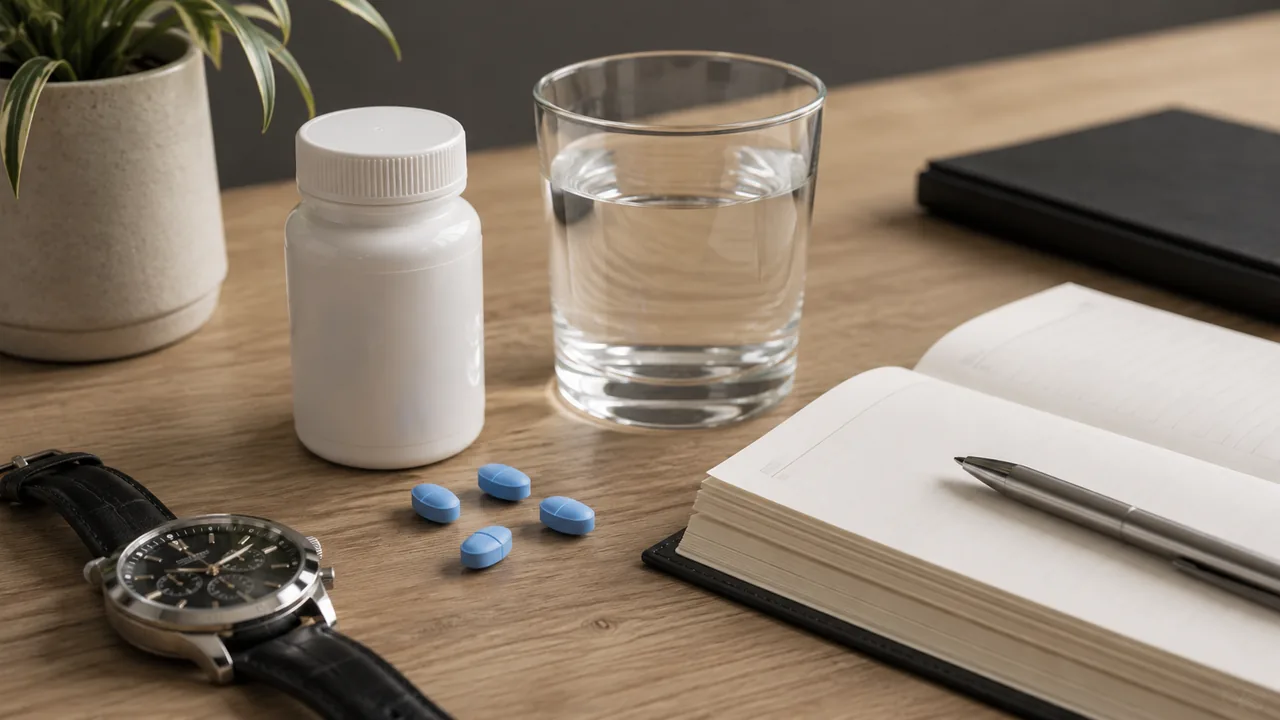
Quick decision comparison
| Decision factor | Daily tadalafil | As-needed tadalafil |
|---|---|---|
| Routine | Ongoing prescribed regimen | Taken around anticipated activity |
| Planning pressure | Less event-specific | More event-specific |
| Medication exposure | Regular | Intermittent |
| Best question | Do I want ongoing readiness? | Do I prefer occasional use? |
| Dose changes | Prescriber only | Prescriber only |
The table is for comparison and question preparation, not prescribing. Individual suitability depends on medical history, other medicines and clinician guidance.
This is not a “which dose is stronger?” page
The key distinction is treatment strategy, not self-selected dose. Daily and on-demand tadalafil use different prescribed dosing approaches. A user should never convert one into the other by improvising frequency.
Why daily use appeals to some couples
Removing the need to decide exactly when to take a pill can reduce event-based pressure and make sexual activity feel less scheduled. That convenience can matter as much as pharmacology for some users.
Why as-needed use still makes sense
Other people prefer not to take an ED medicine every day, have infrequent sexual activity, or simply prefer event-based treatment. The fact that daily tadalafil exists does not make it the more advanced or more effective choice for everyone.
Why the search intent matters
Someone comparing specific ED medicines is usually past basic awareness. The decision is about fit: how treatment timing interacts with real life, whether previous response was consistent, which adverse effects were tolerable, and whether the person values a short planned window or more flexibility. That is why this guide focuses on decision factors rather than declaring a universal winner.
What “works better” actually means
For ED treatment, “better” is not one number. A medicine can be clinically effective yet be a poor fit because the timing feels restrictive, a meal delays the expected response, an adverse effect is bothersome, or the person wants a different dosing pattern. A useful comparison therefore separates efficacy from convenience, tolerability, onset, duration and medical suitability.
Why treatment response can look inconsistent
A disappointing experience does not automatically prove that a medicine has permanently failed. Timing, food, alcohol, sexual stimulation, adherence to prescribing instructions, anxiety, relationship context, other medicines and underlying health can all influence the real-world experience. Repeated poor response is a reason to review the situation with a qualified clinician, not an invitation to self-escalate or stack drugs.
Safety belongs inside the comparison
PDE5 inhibitors can interact with other medicines and are not suitable for everyone. Nitrate medicines are an especially important contraindication to discuss with a clinician. Online comparisons are useful for preparing questions, but they cannot replace review of blood pressure, cardiovascular history, other prescriptions, kidney or liver issues and previous adverse reactions.
How to use this page before an appointment
Write down what you tried, when you took it, whether food or alcohol was involved, how long you waited, whether there was adequate sexual stimulation, what response occurred, any adverse effects, and what you actually want from treatment. That short record turns a vague “it did not work” conversation into something a prescriber can assess much more efficiently.
Why brand names can distort the decision
Viagra, Cialis, Levitra and Stendra are memorable brand names, but the clinically relevant comparison is between their active ingredients and treatment profiles. Generic availability can also change the cost conversation. Searchers should compare the medicine, not assume a famous brand is inherently stronger or more suitable.
Daily versus as-needed is a routine decision, not a potency contest
The daily-versus-as-needed tadalafil question is often framed as if one schedule must be stronger. That is not the most useful way to think about it. The two approaches are different routines, and the decision depends on frequency of sexual activity, preference for planning, tolerability, other medicines, clinician guidance and whether a person is likely to follow the schedule consistently.
A daily routine may appeal to someone who dislikes planning around a specific event, while an as-needed routine may appeal to someone who prefers taking medicine only when it is expected to be used. Those preferences are practical, but they do not replace medical considerations. The same active ingredient is involved, and the dose and schedule should not be changed without professional guidance.
Before discussing a switch, record how often treatment is actually needed, whether doses are missed, whether side effects are persistent, and whether the current routine creates friction or uncertainty. That turns a vague preference into information a clinician can use. It also helps distinguish a schedule problem from a treatment-response problem, which are not the same thing.
Related decision pages
Frequently asked questions
12 questions people ask before making this decision
Is daily tadalafil the same drug as Cialis?
Tadalafil is the active ingredient associated with Cialis. Daily and as-needed use are different prescribed regimens.
Can I turn my as-needed prescription into daily use myself?
No.
Does daily tadalafil work instantly?
It is an ongoing regimen, not an “instant” treatment claim. Follow the prescribed instructions.
Is daily tadalafil better for spontaneity?
It can reduce event-specific dose timing, which some users value.
Is as-needed tadalafil cheaper?
Cost depends on dose, quantity, insurance, generic pricing and market. Compare actual prescriptions rather than assuming.
Should I change my ED medication dose based on this page?
No. A comparison page cannot account for your full medical history, prescription instructions, kidney or liver function, blood pressure, other medicines or prior adverse effects. Dose changes should be discussed with the prescriber or pharmacist.
Can two prescription ED medicines be combined?
Do not combine prescription ED medicines unless a qualified prescriber specifically directs it. Combining PDE5 inhibitors can increase adverse-effect and blood-pressure risk and makes a poor response harder to interpret.
Do ED medicines work without sexual stimulation?
PDE5 inhibitors support the erectile response to sexual stimulation; they do not create desire or cause an automatic erection. Response varies among individuals and circumstances.
When does persistent erectile difficulty deserve medical evaluation?
Persistent, worsening or newly changed erectile difficulty deserves professional evaluation, particularly when it appears with other health changes, new medicines, cardiovascular symptoms, diabetes or after prostate treatment.
Can supplements interact with prescription ED medicines?
Yes. Supplements can interact with medicines, and some sexual-enhancement products have been found to contain undeclared prescription-drug ingredients. Share your complete supplement and medication list with a clinician or pharmacist.
What is the RealVigor assessment for?
The RealVigor assessment organizes treatment history, priorities, tolerability concerns and decision paths. It is educational and does not diagnose ED, prescribe medication or clear a medicine as safe for you.
What should I record before comparing option 1?
Record the medicine used, the prescribed instructions you followed, timing, food or alcohol around use, response, adverse effects and your main treatment priority. That information is more useful than guessing from a single experience.
Sources used for this decision guide
Primary or high-authority medical references. The page deliberately avoids pretending an online article can provide individual medication clearance.
Turn the comparison into a clearer next step
The RealVigor quiz organizes what you have tried, what bothered you and what matters most to you. It does not prescribe a drug, which is rather less exciting than internet bravado and considerably more useful.
Start the 60-Second Assessment